
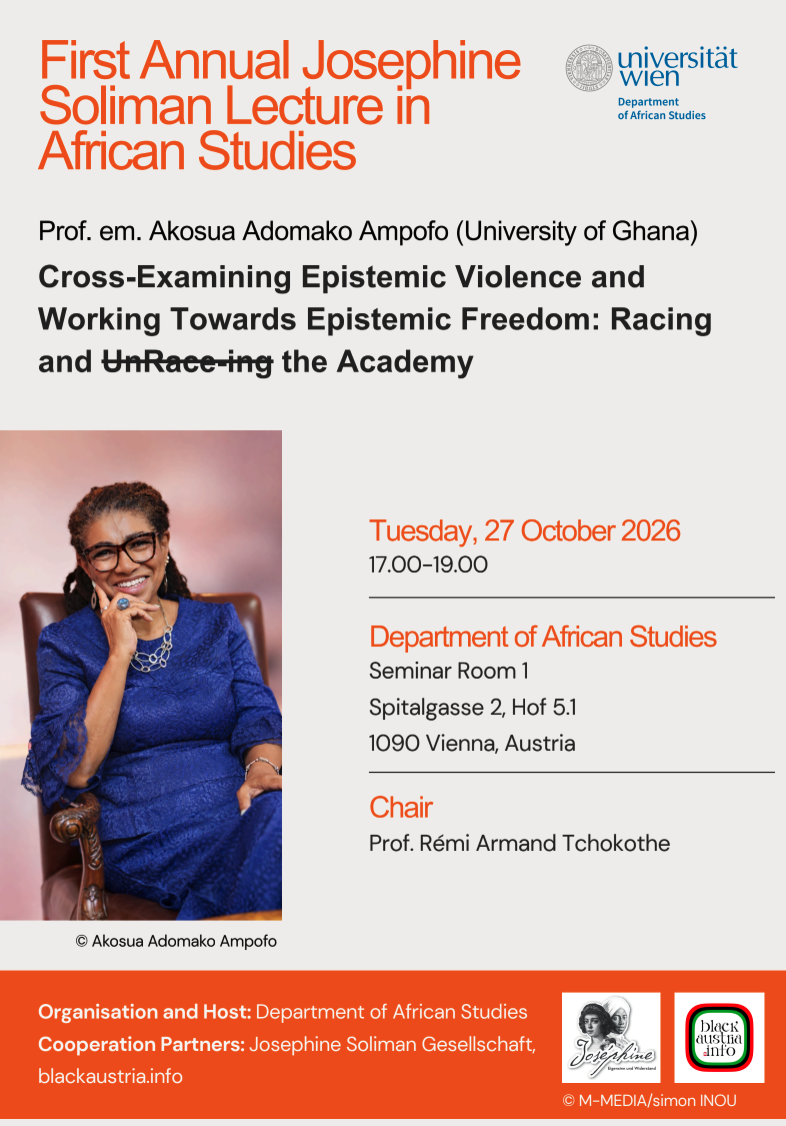
Cross-Examining Epistemic Violence and Working Towards Epistemic Freedom: Racing and UnRace-ing the Academy
Inspired by Josephine Soliman’s protest against the public display of her father Angelo Soliman’s remains and her demands for a dignified burial for him, in this lecture I seek to exhume African Studies from caricature — not for re-burial, but reconfiguration. The discipline has had diverse historical, political and epistemological fortunes and I will synthesize my thoughts from the last several years on the now very popular (albeit by no means new) decolonize project, to reflect on how, given contemporary geo-politics, the intensely political project of knowledge production can provide epistemic freedom and intellectual sovereignty for “African knowers” and why this is
important for scientific knowledge production.
To do this, we must confront race unapologetically. The academy has often treated matters of race as acute — say, when student movements have demanded we decolonise the academy, or around questions of hiring “minorities”. As soon as these matters are presumably attended to, there is a return to chronic invisibility. Furthermore, insufficient attention has been paid to analysing how scientific enquiry even today, such as methodologies, epistemologies, partnerships, and academic rankings are racialized and lead to erasures or misrepresentations. In my talk I will illustrate some of these conditions and suggest why “raceing” the academy — i.e. seeing race — and then “unracing” — i.e dismantling racialised structures — is important for how we can ultimately make the higher education space safer, freer, and more productive for us all. At its core, reconfiguring African Studies implies exhuming the corpse, then unsettling what constitutes knowledge, its measurement, and dissemination, to challenge oppressive orthodoxies.
Who is Professor Akosua Adomako Ampofo ?
Akosua Adomako Ampofo is an Emerita Professor of African and Gender Studies at the Centre for Gender Studies and Advocacy, University of Ghana (UG), where she was foundation Director from 2005-2010 and from 2010-2015 Director of the Institute of African Studies at UG. Her work examines the politics of knowledge (production); gender relations; and masculinities. Adomako Ampofo’s work integrates critical theory with artistic expressions, highlighting the transformative power of the arts in advocating for marginalized voices and healing and justice work. In 2022 she co-produced the award-winning documentary When Women Speak with Kate Skinner, directed by Aseye Tamakloe. She has been a Fellow at the Rockefeller Foundation’s Bellagio centre; a Mellon Fellow at the Centre for African Studies at the University of Cape Town and a three-time Fulbright Scholar. In 2024 she co-founded 715House Productions Ltd., dedicated to reshaping narratives about (global) Africa through storytelling.